
Universal Music Group sues DistroKid: what it means for independent artists
Universal Music Group filed a federal lawsuit against DistroKid, alleging deceptive business practices and large-scale facilitation of copyright infringement. At Mh Musik we follow this kind of case closely because it hits independent artists directly. Here’s the essentials.
What happened
According to the complaint filed in the U.S. District Court for Delaware, UMG accuses DistroKid of distributing more than 1,000 recordings that infringe its catalog — including sped-up and slowed-down versions of tracks by Ellie Goulding, Sam Smith & Kim Petras, Shontelle and other artists. Damages sought reach $150,000 per work under U.S. federal copyright law.
DistroKid was contacted for comment; at the time of publication the company had not issued a detailed public statement. Everything here is alleged; no court has made a finding of liability.
Two distinct fronts in the lawsuit
The complaint attacks in two directions:
- Stolen songs. UMG alleges that DistroKid distributed and monetized manipulated versions —sped-up, slowed-down or otherwise altered— of recordings owned by UMG. This is the copyright claim, with the $150,000 per work in damages.
- Fake songs. No copyright claim here. UMG points to Suno-AI-generated tracks distributed by projects like “Chill Flow Radio” and argues that DistroKid sells itself as a distributor of music made by humans while —per the lawsuit— pumping “AI slop” onto the platforms. It’s framed as deliberate deception with market harm.
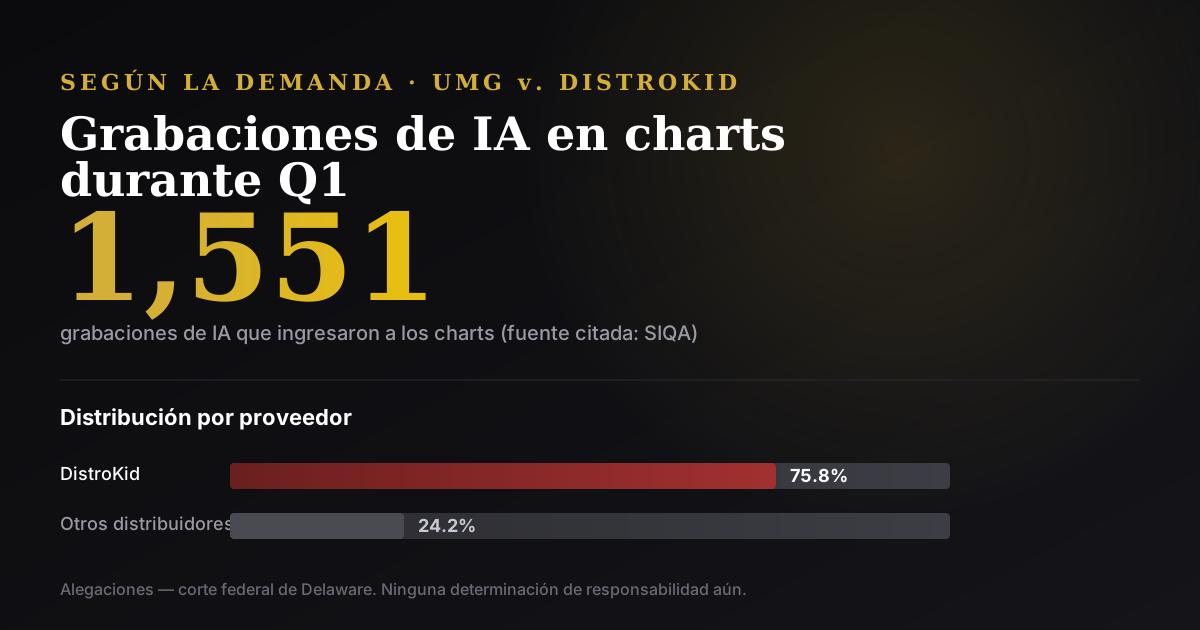
The data cited in the complaint: of 1,551 AI-generated tracks that entered the charts in Q1, 75.8% were allegedly distributed through DistroKid (source: SIQA).
The key question: did DistroKid know?
To win the copyright front, UMG has to prove DistroKid knew it was distributing infringing tracks — not that it was a passive pipe.
According to the complaint, when a rights conflict surfaces on YouTube’s Content ID, a DistroKid employee manually logs in and clicks to either claim the recording or admit the company has no rights in it. UMG alleges that, on the sped-up and slowed-down versions, DistroKid staff repeatedly confirmed the company held no rights — and yet, per the lawsuit, DistroKid kept distributing those recordings to other platforms and collecting royalties.
Context: the CVC sale on a deadline
DistroKid is in the process of being sold to CVC Capital Partners at a reported ~$2 billion valuation. Per the deal announcement, closing was expected “subject to customary conditions” in Q3 2026 — a window that ends in about 15 days. A federal lawsuit of this size, right before closing, is anything but coincidence.
Precedent: UMG has settled a similar case
Earlier this year, UMG and Believe/TuneCore resolved a similar dispute through a settlement. It wouldn’t be surprising if this case also settles — but the terms and commitments made can reshape how the distribution industry operates.
What it means for the independent artist
- More verification across the industry. Distributors will very likely tighten identity checks and rights validation.
- Possible takedowns. DSPs act against fraudulent content; the distributor’s collective reputation affects you even if your music is original.
- Distributor reputation matters. DSPs reward rigorous distributors with priority and penalize the ones without it.
- The honest artist wins. If you release original music or covers with proper licenses, you’re fine — just distribute with someone who verifies upfront, not after the fact.
Where Mh Musik stands
At Mh Musik we operate a different model by design: curated catalog, rights verification on every release, mechanical licenses managed for covers, and compliance with each DSP’s anti-fraud policies. We verify before sending the music to platforms, not after.
We’re not using this case to attack other distributors — every artist picks the model that works for them. We just want to be transparent about how we work.
The takeaway
The case will take months or years. But the signal is already clear: verification-free distribution has a cost, and someone eventually pays it. For the independent artist, choosing a distributor is no longer just about price.
Want to see how Mh Musik distributes? Explore our VIP plans and distribution services.